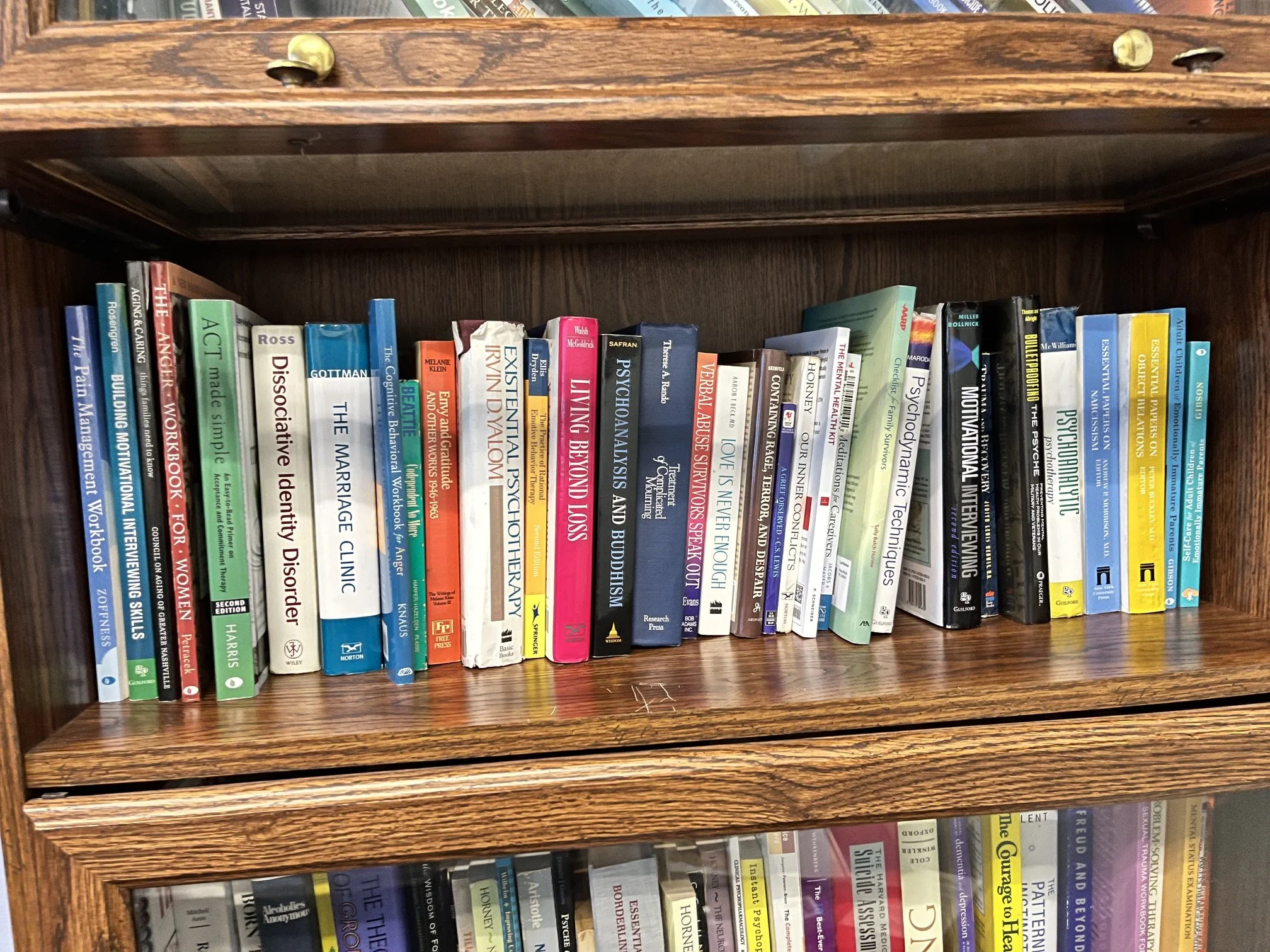
DIY and Professional Books
These books are varied, interesting, and reflect my broad curiosity on mental health approaches. For some, finding self help books a good idea, if you have the time and current strength to do so.
“The Expectant Father, The ultimate guide for the expectant Father”. Brott, Rudick. It may save a few early marriage arguments- or even an early marriage. [side note: Where is the book:’ Spouse/Partner’s guide to surviving peri-menopause’?]
The Pain Management Workbook , Rachel Zoffness, MA, PhD. The body directly effects psychology. Diabetes, Thyroid and a bunch of others imitate-are part of-Depression. Pain and Depression, living with pain, and finding ways to decrease pain without more meds, or surgery, is a necessary fact for a huge population. A great book for those that need it.
AARP Series for Older Folks. “Checklist for Family Survivors” and “Checklist for Family Caregivers” Sally Balch Hurme. These kinds of self help books can be immensely helpful, as almost all families, caregivers, and patients are overwhelmed at the time, and often at the same time, when dealing with crisis or chronic conditions.
“The Complete Family Guide to Schizophrenia: Helping Your Loved One Get the Most Out of Life”Recent diagnosis of schizophrenia in the family? Get support from as many directions as is practical. A new diagnosis, often for a family member 16-23, is life changing, family changing. A strong person/family knows when to ask for help. Shop around. Buy one for a stressed out caregiver/family member.
“Self Care for Adult Children of Emotionally Immature Parents”, William Knauss, and “Adult Children of Emotionally Immature Parents” by Lndsay Gibson. Childhood is where we start from, and Childhood feels normal, because we lived it. And survived. And passed it down. The idea? you can sometimes map where you are now to a family or parent that was not ready, or in a chaotic environment. They may have grown now, or not. Or maybe they are now unavailable.
“It’s Not You, It’s What Happened to You: Complex Trauma and Treatment” Dr. Christine Courtois, PHD Dr Courtois has said this book is for the public. Be Warned: It has strong content, and can also be very useful, but a starting with a therapist may be a better first choice. Getting grounded comes first. Working on the past means being steady and grounded today. Before any look at the past, getting strong and steady today starts first. And can take time.
For Professionals: The Treatment of Complex Trauma, A sequence, relationship based approach. Christine Courtois, PhD, Juliane D. Ford, et al. Brilliant. Practical.
Various national experts in trauma Website: https://www.thetraumatherapistproject.com. Gotta say it again. Get grounded first please. Make today safe and stable, and stay connected with a close person before and during any exploration.
“Verbal Abuse Survivors Speak Out, On Relations and Recovery”. Patricia Evans. If this upsets- please put it down. Seek out human support first before reading this. Therapist, trusted friend, trusted family.
“The Cognitive Behavioral Workbook for Anger” 2020. William Knauss
“The Anger Workbook for Women” 2004Laura J Petracek.
“Imperative People: Those Who Must Be in Control “Les, Carter, 1991 Many men and women have to learn and heal their way out of always being in control. You miss a lot when you grip too tightly.
“I Don’t Want to Talk About It” 1997, Terrence Real. Men and Depression, in many, many forms. A good read.
“Love is Never Enough” , 1988, Aaron Beck. A good one for becoming aware of relational/spousal issues. For DIY and professionals.
Existential Psychotherapy” 1970 Irving Yalom. If you’re wonky and like theory, a big book that gives you a great idea of what Existentialism is and how it leaks into the therapy room. Death, Freedom, Isolation, and Meaninglessness, topics we all must face.
“The Practice of Rational Emotive Behavior Therapy” 1997. Albert Ellis, Windy Dryden. Ellis becomes a foul- mouthed curmudgeon (in a friendly way that makes me smile) at the end of a long career, when interviewed. He and Beck are founders of CBT. and ReBT, (or RT.) Both extremely effective and the core of a majority percentage of all Evidence based therapies today. For Professionals.
“ACT Made Simple” 2009, Russ Harris Simple. Practicle. Module by Module. Good tools to move forward today.
Motivational Interviewing: Preparing People for Change (2nd ed.) Miller. 2002 A different take for Substance abuse than AA- broadened into therapy over time, now even used by politicians and marketers. Good for getting traction for change. Professionals.
“The Alcoholic Family” Steinglass, 1987. This focuses on families who make Alcohol the central part of the family. He breaks down these families into stages: Early, Middle, and Chronic..Do thye have anything in common? surprisingly- they do!. Chronic, where the old family declines from alcohol, and the next gen adopts everything their parents did and do. While you may not now be in an ‘alcohol-centered family’ chances are you know one, spouse has one, or have one in extended family, or grew up in one. It explains some things often left unsaid. There are hundreds more. I have used books like these, alongside direct professional training and peer consultation throughout my career.
Looking online, DIY, working things out is good for some. A good deal of evidence based therapy is intended for you to take out of the office, and try at home. Psychodynamic therapy is longer, and takes more time. I am trained in both. As I am endlessly curious, I have sampled broadly, looking for therapy that fits.
Follow what fits you, and at a pace and time when you are ready for change. Take a breath. First,Get grounded. Start with today. Find out what to tackle first. Triage. Therapy can help with that.
Ask for support when you need it. And be patient with yourself.